The Dishes That Only Get Made for Celebrations
When Food Becomes More Than Food
There are some dishes that never appear on a regular Tuesday. They do not show up because someone felt like cooking something new. They arrive only when the occasion calls for them, when the calendar turns to a specific day, when the house fills with people, and when the kitchen transforms into something closer to a ritual space. Indian festival food traditions are not just about what is eaten. They are about what the act of making and sharing that food means to the people gathered around it.
Food in India has always been inseparable from celebration. Every festival, every community, every region has its own set of dishes that exist almost exclusively for occasions. These are not everyday recipes. They are traditional Indian celebration dishes passed down through generations, made with more care and more time than the weekday meal, and eaten with the full awareness that today is different from any other day.
These dishes carry memory in a way that regular food simply does not. The smell of them from the kitchen is often enough to bring back a childhood festival morning in full. That is the power of festival food culture India has built over centuries. Not just flavour. But feeling.
The Dishes That Know Their Season
The One Dish That Belongs to Ganesha First
Kozhukattai is shaped, filled, and offered to Ganesha before a single one is eaten. That sequence matters. The dish is not just food. It is an offering first and a meal second. Made from rice flour and filled with sweet coconut and jaggery, or sometimes a savoury stuffing, Kozhukattai appears in South Indian homes specifically for Vinayagar Chaturthi and almost never outside of it. The making of it is a family ritual, with everyone present and involved. This is one of the most recognisable South Indian festival dishes there is.
Before the Carols, There Was the Cake
In South Indian Christian homes and across communities that celebrate Christmas, the cake is not just a dessert. It is the announcement that the season has arrived. Rich with dry fruits soaked weeks in advance, spiced and dense, the Christmas cake is made or ordered with anticipation. It is sliced and shared with neighbours, colleagues, and strangers. The Goan Bebinca, a layered coconut dessert cooked one patient layer at a time, holds the same position in its community. Neither is made without a reason, and both are celebration food traditions that the calendar keeps alive.
The Dish That Feeds the Whole Street
Haleem is slow-cooked for hours, sometimes through the night, in large vessels shared across an entire neighbourhood. What makes Haleem extraordinary is not just its flavour but its intention. Made during Muharram and distributed freely across communities regardless of faith, it is one of the most generous expressions of Indian festival food traditions there is. A dish that feeds strangers as readily as family. The act of sharing is inseparable from the dish itself.
The Only Dish Where Spilling Is a Sign of Abundance
Sakkarai Pongal is made on Pongal morning in a new clay pot, and the moment the pot boils over is celebrated rather than corrected. The overflow is a sign of abundance and prosperity. This is one of the few Indian harvest festival foods where the cooking itself is the ceremony. Rice, jaggery, ghee, and cardamom come together in a dish that is as much about gratitude as it is about taste. It appears once a year and carries the weight of the entire season.
The Sweet That Belongs to a God
Modak is Ganesha's favourite food, and that relationship between a dish and a deity is what makes it so specific to its occasion. Steamed or fried, filled with coconut and jaggery, Modak is made and offered before it is eaten. In many homes, the women of the family fast until the offering is complete. As a traditional Indian celebration dish, Modak is perhaps the clearest example of food as devotion rather than just nourishment.
The Weeks Before Diwali Smell Like This
Diwali does not have one dish. It has an entire category. The weeks before Diwali in Indian homes are spent making snacks and sweets in large batches — Chakli, Murukku, Mixture, Ladoo, and Barfi — that are then distributed to family, friends, and neighbours. The making is a communal activity. Mothers and grandmothers in the kitchen together, each with a specific role. The festival food culture India celebrates through Diwali sweets is as much about the process as the product. You do not just eat Diwali. You make it.
When the Banana Leaf Is Full, Onam Has Arrived
Avial is one of over twenty dishes served on a banana leaf as part of the Onam Sadhya, the grand feast of Kerala. A mix of vegetables cooked in coconut and curd, it holds its own in a spread that could easily overwhelm it. What makes Avial a traditional Kerala celebration food is that the full Sadhya is assembled only on Onam. The rest of the year its components exist separately, but the complete experience belongs exclusively to the festival. When the banana leaf is laid with all twenty dishes, something ceremonial begins.
Every Celebration Deserves a Table Worth Remembering
What all of these dishes have in common is that they are not made lightly. They ask for time, for care, and for the awareness that something significant is happening. They are the traditional Indian celebration dishes that turn a date on the calendar into a memory that stays for years. The occasion shapes the food, and the food shapes the occasion.
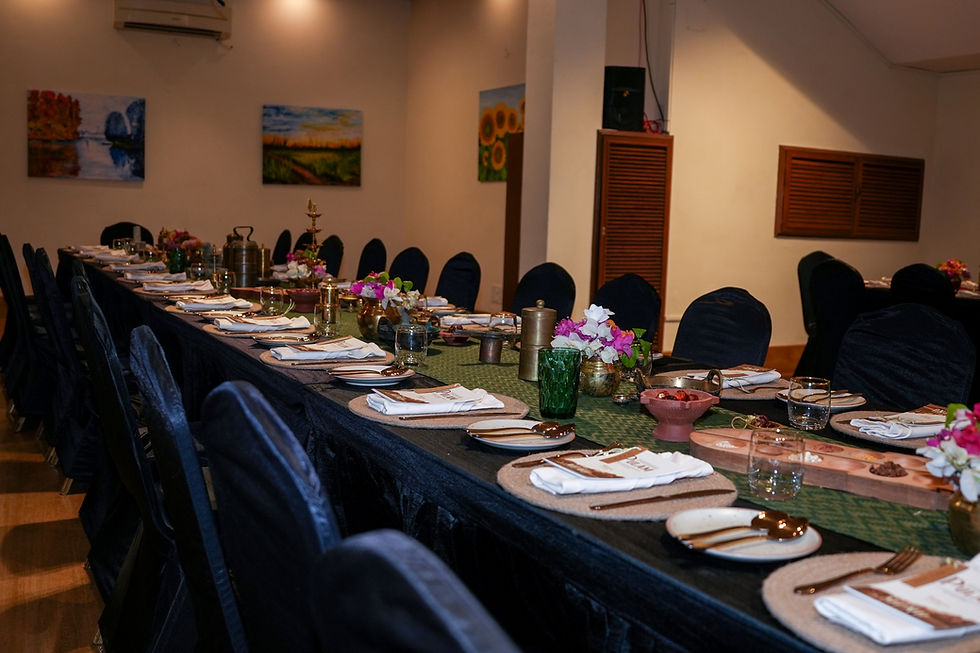
At Pushpa's Kitchen, we believe that every celebration deserves food that matches the significance of the day. Whether it is a festival, a family gathering, or a curated dining experience built around a specific cuisine and culture, we bring the same intention to every table we set. Indian festival food traditions are not just history. They are living, breathing rituals that deserve to be honoured every time they arrive.
If you are planning a celebration and want food that carries the weight of the occasion, we would love to be part of it. From curated festive events to chef-led dining experiences rooted in tradition, Pushpa's Kitchen is built for exactly this kind of moment.
Some dishes only come around once a year. That is what makes them worth waiting for.
📞 Pushpa's Kitchen: +91 74068 86600


Comments